Artificial intelligenceYou want to bring AI into your company. Where do you start?
Artificial intelligence opens up new possibilities, but an impressive demo is not enough to improve how people work. Before choosing a tool or deploying an AI agent, you need to pinpoint the tasks involved, assess the quality of the data and decide who controls the results. Kopus turns that thinking into concrete use cases suited to your business.
The path of a use caseFive steps, and the right to stop at any of them
An AI use case moves forward in stages: after each step, we decide to continue, adjust the scope or stop. This discipline avoids projects that linger at the prototype stage as much as deployments nobody really approved. It also keeps spending predictable, since each stage only commits the next step.
- NeedA precise business situation: frequency, complexity, risk if something goes wrong, gain you want to measure.
- Decision: continueadjust the scopestop
- Authorised dataThe sources the system may consult, the access rights and the confidentiality conditions.
- Decision: continueadjust the scopestop
- PrototypeA first version assessed on real scenarios: relevance of the answers, possible errors, ease of use.
- Decision: continueadjust the scopestop
- Human controlWhat the system may consult, suggest or execute on its own, and what waits for approval.
Still subject to approval
- Any action that changes data in a software application
- Any answer that commits the company
- Uncertain cases, flagged rather than decided
Without approval: consult, search, propose a draft.
- Decision: continueadjust the scopestop
- MeasurementCriteria set in advance: time saved, validated answers, errors avoided. Then the decision to extend, or not.
- A deliberate stopSometimes an automation without AI is enough, or the need does not justify the investment.
What we seeStart from a business situation, not from a technology
A customer service team needs to find answers in hundreds of documents. A sales team needs to prepare meeting summaries. Employees spend part of their day filing or reconciling information. These situations may lend themselves to AI, but not all in the same way.
We first examine the problem: how often it occurs, how complex it is, the data available, the risks if something goes wrong and the gains you want to measure. A simple automation without AI can sometimes meet the need at lower cost and with more predictability.
Our approachChoose the right level of assistance and autonomy
A document search function does not carry the same risks as an assistant that drafts a customer reply, let alone an agent allowed to change data in a software application. We define precisely what the system may consult, suggest or execute.
Where the context requires it, sensitive actions remain subject to human approval. Permissions, traceability, confidentiality and fallback cases are part of the design. The goal is a useful tool, not an autonomous system by default.
How we workFrom the first test to a lasting integration
Kopus frames a use case with the teams concerned, selects the sources and builds a prototype assessed on real, representative scenarios. We test the relevance of the answers, the possible errors and the ease of use before deciding on an extension.
If the test is conclusive, we work on the integration with your tools, the usage guidelines, rights management and monitoring. If the results are not good enough, we say so and adjust the scope or the solution.
What you gainWhat we actually measure
The criteria depend on the use case: time needed to find a piece of information, share of answers correctly validated, number of requests handled with assistance, errors avoided or workload shifted to higher-value tasks.
We avoid presenting AI as a guaranteed gain. Its relevance is proven in your working conditions, with your data and your users.
 AI & automation
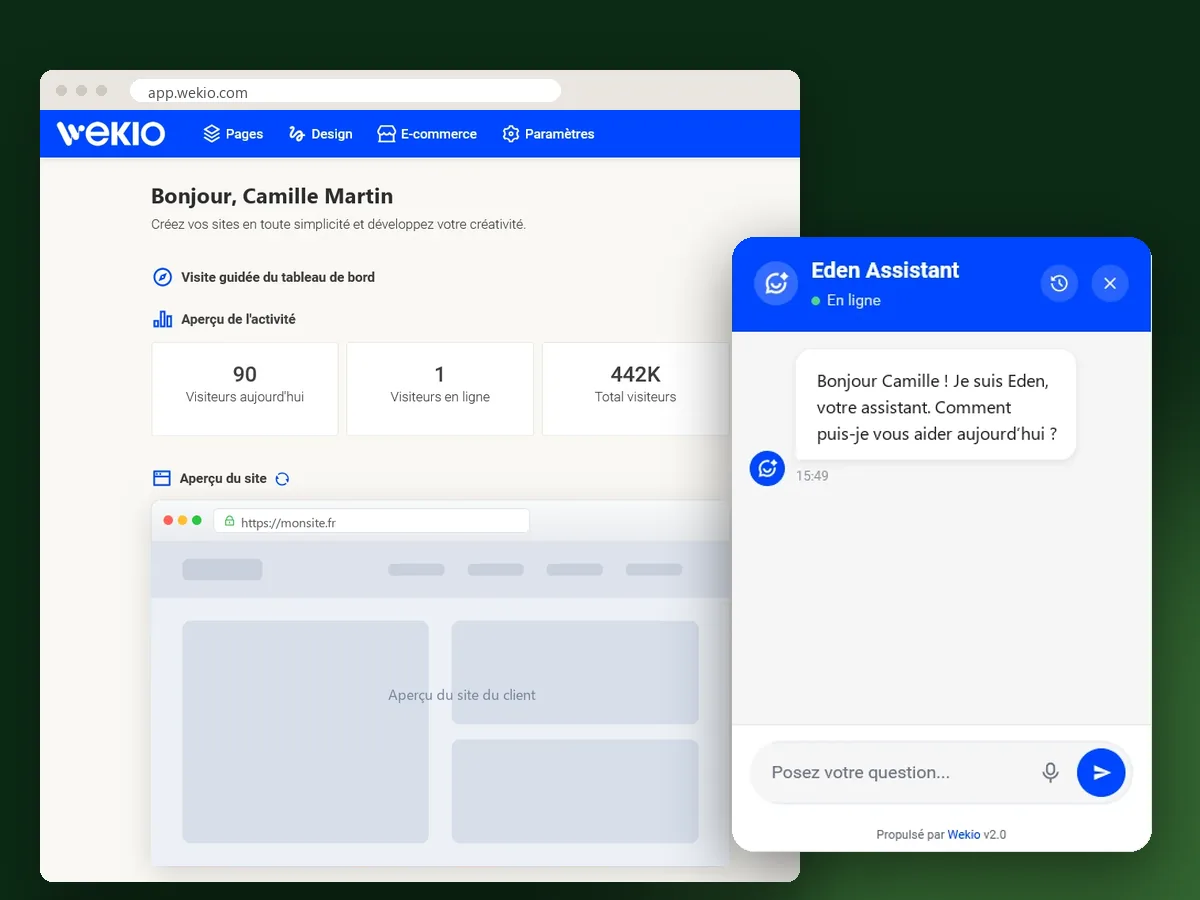
Eden, the AI assistant built into the Wekio platform
See the projectProjectA concrete use case: Wekio support
Kopus designed for Wekio a technical support chatbot that answers users’ questions from its documentation and passes the request to the support team when human intervention is needed. The project shows the value of a defined documentary scope and of a way to escalate.
Your questionsFrequently asked questions
Ask a questionDo we need a very precise AI project already?
No. You can present us with a line of work, a tedious task or a goal. We help you decide whether AI is really the appropriate answer.
Can the AI use our internal documents?
It may be possible depending on the tools, rights and constraints chosen. The accessible sources, the processing conditions and the protection of information are defined before deployment.
Can we require human approval?
Yes. The system can limit itself to proposing a draft, flagging an uncertainty or asking for confirmation before an action. The level of control must match the risk.
How do we avoid a project that never leaves the prototype stage?
By setting from the outset a target user, a business process, evaluation criteria and deployment conditions. A prototype is only worth something if it helps make a decision.
Related servicesThe services that address this challenge
- 04 · AI & automationAI integration for businessEveryone tells you that you need to “do AI”. Nobody tells you where, how, or at what cost. We help you answer those three questions, then act on the cases that are worth it.
- 04 · AI & automationAI agent developmentAn AI agent does not just answer: it acts. Qualifying a request, preparing a quote, updating a file, following up with a customer. We design useful, bounded, supervised agents that fit the way you work.
- 04 · AI & automationCustomer support chatbotCustomer support is the first place where AI makes a measurable difference: response times, satisfaction, team workload. We set up a smart first level, and make sure your customers never feel they are facing a wall.
- 04 · AI & automationBusiness process automationEvery company has processes everyone does by hand because “it has always been this way”. We spot them, simplify them, then automate them, with or without AI depending on what is most reliable.
Your challengesRelated challenges
I want to launch a SaaS platform
Go from your product idea to a first platform that can be operated.
Explore this challenge Your challenges · 09I want to take my business international
Choose the right markets, adapt your offer and roll out step by step.
Explore this challenge Your challenges · 14I don’t know how to succeed in my digital transformation
Turn a vague imperative into concrete, ordered and adopted projects.
Explore this challengeLet’s bring your projects to life
AI should solve a real problem, not create a new one.
Tell us about your uses, your constraints and the tasks that deserve to be simplified. We will look with you at what deserves a test, and what does not need AI at all.