Practice 03 · Web, software & digital solutionsCustom software development: when off-the-shelf stops being enough
A packaged product covers most of what you need, and the part it misses is precisely what sets you apart. So you work around it, export, pay for add-on modules, and in the end the business bends to fit the tool. Custom software development reverses that relationship: the software is built around your rules, your data and your integrations, and it belongs to you.
Written feedback within 48 hours, no commitment
Who it is for, and whenWhen custom software is justified
It answers situations where the gap between a market product and the reality of the company costs something every day.
- Your activity rests on rules (pricing, scheduling, compliance) that vendors do not know, or handle through fragile configuration.
- You depend on an old application written long ago by a supplier that has since disappeared, and nobody holds the code or the documentation.
- You pay per-user licences for a tool you use a fraction of, and every adaptation means a quote from the vendor.
- Several standard products share a single process, and the exchanges between them rely on exports, macros and people.
The scopeWhat a custom software project with Kopus includes
- An honest feasibility study: custom development is weighed against existing solutions, including build and maintenance costs, before any commitment.
- Functional specifications: business rules formalised, edge cases, states and transitions, written in language your teams can review.
- Architecture: module breakdown, database choice, programming interfaces for future exchanges and a hosting strategy (on-premise server, hosting provider or cloud).
- Development in versions, each delivered to a test environment, with automated tests on the critical rules.
- Technical and functional documentation, the source code in a repository under your name, installation and backup procedures.
- A maintenance and evolution plan listing the dependencies to watch and the points that will need updating.
- Widely used languages and frameworks (for example Python, Java, C#, PHP or TypeScript), chosen so that others could take over the code without us.
What you get
- Software that does exactly what you need.
- Controlled costs, with no per-user licences.
- A company asset, documented and transferable.
The methodThe custom software development cycle
Analysis of usage and rules
Observation of real operations, interviews with the people who apply the rules daily, inventory of exceptions.
Build or buy decision
A reasoned comparison between an adapted market solution and specific development, sometimes concluding with a mix of both.
Technical design
Architecture, data model, exchange interfaces and technology stack, documented before the first line of code.
Testable versions
Development in functional batches, each checked on real data by the users concerned.
Go-live and handover
Deployment, migration of existing data, training, delivery of code and documentation, then maintenance under the agreed plan.
Delivery in versionsSoftware that grows one version at a time
The core is laid down in the first version: architecture, data model and automated tests on the critical rules. Each later module plugs into it without weakening what already works. Between two versions, it is user feedback on real cases that sets the order of the next modules, more than the initial specification.
MVPOne use covered end to end
- CoreArchitecture · data model · automated tests
- Users and permissions (New in this version)
- Data entry and business rules (New in this version)
User feedback
Version 1Extended once adopted
- CoreArchitecture · data model · automated tests
- Users and permissions
- Data entry and business rules
- Approval workflow (New in this version)
- Reporting (New in this version)
User feedback
Version 2Connected to other systems
- CoreArchitecture · data model · automated tests
- Users and permissions
- Data entry and business rules
- Approval workflow
- Reporting
- ERP and accounting integrations (New in this version)
- Document generation (New in this version)
Technical coreAlready in productionNew in this version
Our positionWhere we stand on custom software
Custom software is not an end in itself. It costs more to build than a licence and it has to be maintained, which many companies underestimate. It makes sense when the gains (time saved, errors avoided, independence from a vendor, integrations made possible) outweigh that cost over the long run. When they do not, we say so and point you towards an existing solution, possibly completed by a peripheral development.
Your questionsFrequently asked questions about this service
When should we choose custom software?
When your business constraints, volumes or integrations are not properly covered by existing solutions, and those gaps carry a real cost for the company.
Who owns the code?
You do. Source code, documentation and environment access are handed to your company, which may entrust them to another team if it wishes.
How does the software evolve after delivery?
The modular architecture allows functions to be added without rewriting what exists. Changes are planned in versions, with tests that protect the rules already in place.
Isn’t custom software more expensive?
Upfront, sometimes. Over five years, rarely, once you count licences, workarounds and time lost with an ill-fitting tool. We help you compare honestly.
What happens if we stop working with Kopus?
You keep the code, the documentation and the access. Another provider can take over the project without difficulty: it is a quality criterion we hold ourselves to.
How long does a custom software project take?
Two to six months for a first version in production, depending on scope. Kopus splits the project into successively delivered batches rather than one final delivery.
Go furtherPages related to this service
Our workProjects built on this expertise
All our work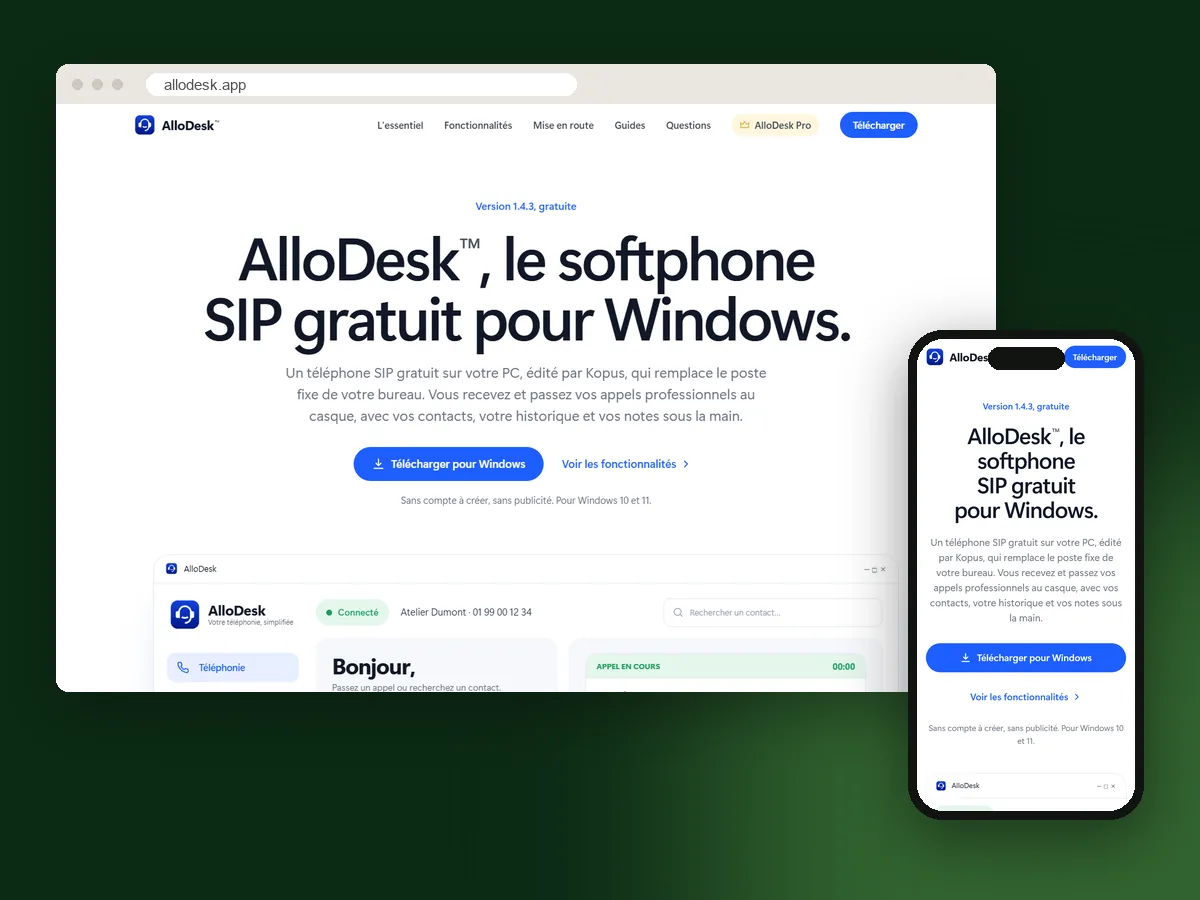
Let’s bring your projects to lifeYour next project starts here.
Let’s measure your requirements against what market software leaves uncovered.
Written feedback within 48 hours, no commitment