Digital product and SaaSYou have an idea for a SaaS platform. How do you turn it into a useful product?
Launching a SaaS is not just about developing features. You need to choose a problem that matters enough, define the users, simplify the first scope, prepare operations and check that the business model holds. Kopus supports you from clarifying the product to putting it online, with an approach that favours real usage.
The roadmap of a productA product moves forward on evidence, not on a feature list
Each stage produces concrete deliverables and ends with a question: have we learnt what we needed to commit to the next one? The scope may shrink along the way, which is often the sign of a product coming into focus. This roadmap also serves as a common language between the project owner, design and development.
01User need
Deliverables
- Target profiles and main task to simplify
- Interviews and prioritised problem
- Solutions already available
What we check before continuing
Checked before continuing
Is the problem important enough to justify a product?
02Value proposition
Deliverables
- What sets the offer apart
- Intended business model
- Scope of the first version, and what can wait
Checked before continuing
Do prospects understand it and show interest?
03MVP
Deliverables
- Essential journey: account, central action, result, support
- Screens, data, roles
- Technical foundation according to the security and integrations required
Checked before continuing
Do real users complete the main scenario?
04Feedback
Deliverables
- Activation and use of the essential features
- Drop-offs and support requests
- Selected improvements, not the list imagined at the start
selected improvements
Checked before continuing
Does actual usage confirm the priorities?
05Operated product
Deliverables
- Hosting, monitoring, backups
- Billing, account statuses, access rights
- Planned evolutions
Checked before continuing
Do costs and priorities stay readable?
What we seeThe first challenge isn’t the code: it’s choosing the product
An idea can solve several problems at once, but trying to cover everything in the first version is expensive and muddies user feedback. We start by clarifying the profiles targeted, the main task the service must make simpler and the difference from the solutions already available.
This step defines what belongs in the first product, what can wait and what needs checking with users or prospects before investing further.
Our approachAn MVP that stands up, without building everything
The minimum viable product is not an unusable draft. It must allow an essential scenario to be completed in good conditions: create an account, perform the central action, understand the result and contact support if needed.
We work on the screens, the data, the roles and the features needed for that journey. The technical choices are made according to the security level required, the integrations, the number of users expected and the ability to make the service evolve.
How we workAlso think about life after launch
An online platform requires decisions on hosting, monitoring, backups, confidentiality, updates and incident management. If subscription is part of the model, the billing rules, account statuses and access rights must also be defined.
Kopus can bring together product framing, UX/UI and development. We organise the validation steps so that the project owner keeps control of the trade-offs.
What you gainMeasure usage to decide what comes next
After launch, the first useful data is not only sign-ups: you need to watch activation, use of the essential features, drop-offs and support requests. This feedback lets you select improvements rather than follow a list of features imagined at the start.
We aim for a product that progresses through informed decisions, with readable costs and priorities.
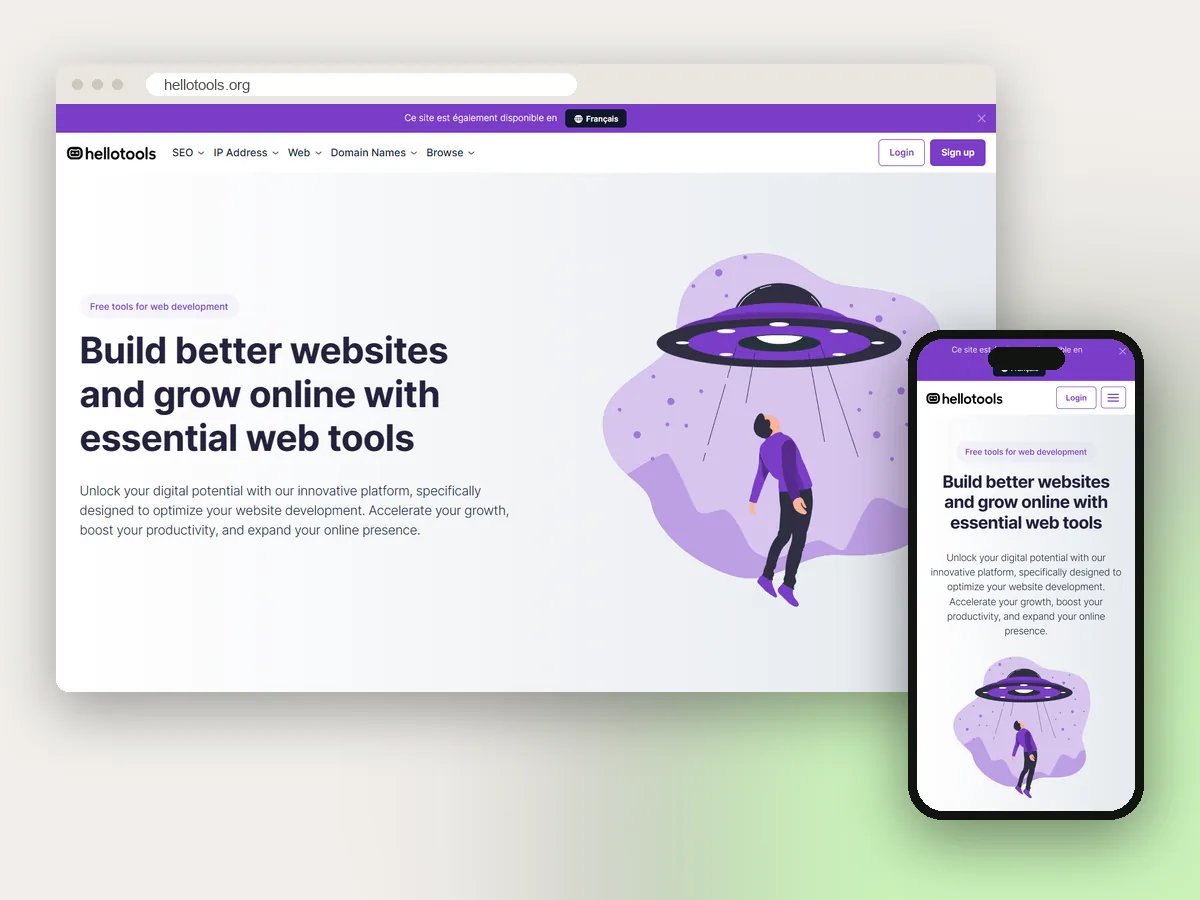 Web platform
Hellotools, a free web toolbox
See the projectProjectKnow-how in web platforms
Kopus designed Hellotools, a bilingual web platform of SEO, IP address and domain name tools, with user accounts. This project illustrates our ability to build a complete online platform: sign-up journey, user area, features used every day and operation over time.
Your questionsFrequently asked questions
Ask a questionDo we need a complete specification before contacting you?
No. An idea, a target audience and the problem to solve are a sufficient starting point. Framing is precisely what builds the useful specifications.
What should the first version include?
The main scenario your users must succeed at, the functions essential to make it work and the elements needed for safe operation. The rest is prioritised for later.
Do we need to build everything before talking to users?
No. A mock-up, a clickable journey or a limited first version is often enough to check interest in the product and correct the scope before investing in full development.
Can I make the SaaS evolve after launch?
That is a design goal. Ease of evolution depends on the architecture choices, the tests, the documentation and the maintenance planned from the start.
Related servicesThe services that address this challenge
- 03 · Web & softwareSaaS platform developmentTurning know-how into a subscription service is a business project as much as a technical one. We build SaaS platforms designed to welcome your first customers quickly, and the next ones without starting over.
- 03 · Web & softwareCustom software developmentCustom software is not a luxury; sometimes it is the only way to do exactly what your business requires. We design it as an investment: useful from the start, solid for the long run.
- 03 · Web & softwareUX and UI designA good interface goes unnoticed: you do what you came to do and leave satisfied. We design journeys and screens that reduce effort, errors and support calls.
- 03 · Web & softwareEmail deliverability and transactional sendingYour emails must arrive. Not in spam, not never. We authenticate your domains and centralise the sending of your websites and software on a reliable infrastructure, monitored and protected against spoofing.
Your challengesRelated challenges
I want to bring AI into my company
Spot the AI uses that make sense and keep control of decisions.
Explore this challenge Your challenges · 09I want to take my business international
Choose the right markets, adapt your offer and roll out step by step.
Explore this challenge Your challenges · 14I don’t know how to succeed in my digital transformation
Turn a vague imperative into concrete, ordered and adopted projects.
Explore this challengeLet’s bring your projects to life
From the idea to a first version your users can genuinely adopt.
Tell us who your future platform is for, the problem it solves and what you imagine for the first version. We will help you frame the priorities.