Practice 01 · Business consulting & strategyBusiness strategy consulting: deciding where to go, and where not to
There is never a shortage of opportunities: a new market, a partnership, an extra product line, an unexpected request from a major customer. Taken one at a time, each looks reasonable. Taken together, they scatter your efforts and leave your teams unable to read what matters. Kopus business strategy consulting clarifies the direction of your company and puts the trade-offs in writing, including the ones that mean saying no.
A scoping conversation, confidential
Who it is for, and whenWhen does strategy consulting make sense?
The need rarely shows up in a crisis. It tends to surface when the business is doing well, requests are multiplying and management no longer has a framework for saying yes or no.
- You run a company that grew through a succession of opportunities and whose current offer no longer forms a coherent whole.
- The partners or the leadership team hold different views of the next few years, and the discussions keep going round in circles.
- A competitor, a regulation or a technology is changing the rules of your sector and you need to reposition the business.
- Your staff are asking for a clear course to prioritise their work, and no document sets one out.
The scopeWhat Kopus puts in writing with you
The work begins with a review of your implicit orientations: the ones already steering decisions without ever having been written down. We test them against your environment (customers, competitors, resources, financial constraints) to see whether they still hold.
You then receive a strategic brief that fits in a few pages: the company’s mission as you define it, the two or three priorities chosen for the period ahead, the criteria that will be used to accept or decline an opportunity, and an explicit list of the activities or projects you are choosing to drop or pause. Depending on your needs, the brief is extended with a breakdown by function (sales, production, human resources, digital) and a review calendar.
Where certain options deserve comparison before a decision, we build contrasting scenarios, each with the resources it requires, its risks and the signals that would indicate a change of course.
Sample decision workshopWhat comes first, and what is dropped
In the decision workshop, each option is placed according to two plain questions: what does it bring to the chosen priorities, and what does it take in time, budget and attention? Its position sets the order of work. Options in the last quadrant go on the written list of things the company will not do, with the date when they may be reconsidered.
High impact, low effort
Quick wins
Start now
- Written criteria for accepting a request
- Dropping low-margin offers
- Repricing the core offer
High impact, high effort
Major projects
Plan and fund
- Entering a neighbouring market
- Distribution partnership
Low impact, low effort
Minor adjustments
If capacity allows
- Consistent sales materials
- Updated quote template
Low impact, high effort
Drop or postpone
Written refusal
- Extra entry-level product lineDropped
- Custom version for a single customerDropped
- Opening abroadPostponed
Shared decision criteria
- Contribution to the chosen priorities
- Resources required
- Risk and reversibility
- Time to first results
The methodHow a strategy engagement runs
Individual interviews with decision-makers to gather existing visions and spot the disagreements nobody has voiced.
Analysis of the environment: competitive position, shifting customer expectations, internal capabilities and financial room for manoeuvre.
A decision workshop with the leadership team to compare the options, rank them and formally record what is being dropped.
Drafting of the strategic brief and decision criteria, reviewed with you until it is usable day to day.
Presentation to the teams and set-up of the review rhythm, so the strategy stays alive rather than becoming an archive document.
Our positionA strategy also states what the company will not do
A strategy that simply stacks up ambitions is useless: it permits everything and helps no one choose. The most valuable part of strategic work is often the list of projects abandoned, customers no longer pursued and markets left alone this time round. Those refusals free up time, money and attention for the chosen priorities. We write them down in black and white, because an unspoken refusal is challenged the moment the next request arrives.
Your questionsFrequently asked questions about this service
What is business strategy consulting for?
Turning broad ambitions into concrete choices, ranked by priority and understandable to the teams who will have to apply them. A department head faced with a new request should be able to say whether it fits the framework or not.
Does strategy consulting replace an audit?
No. An audit diagnoses the current situation; strategy consulting sets the future direction. The two can follow each other, but a company that already knows its situation well can move straight into the strategic work.
What happens when the directors disagree with each other?
It is common, and it is precisely what the decision workshop is designed to handle. Disagreements are laid out with each person’s arguments, then settled on shared criteria rather than sidestepped.
Do you also work on implementation?
Yes, that is our particularity: our brand, digital and AI practices can deliver what the strategy calls for, or support your teams who will.
Do you need to be a large company to need a strategy?
No. A small business choosing between two markets needs clarity as much as a group does. We adapt the format to your size.
What does Kopus deliver at the end of a strategy engagement?
A one-page written strategy, a twelve- or twenty-four-month roadmap with milestones, owners and indicators, and a follow-up ritual, usually quarterly, to adjust it.
How long does a strategy consulting engagement take?
Four to ten weeks for the design phase, depending on company size and the leadership team’s availability, then ongoing support if you wish.
Go furtherPages related to this service
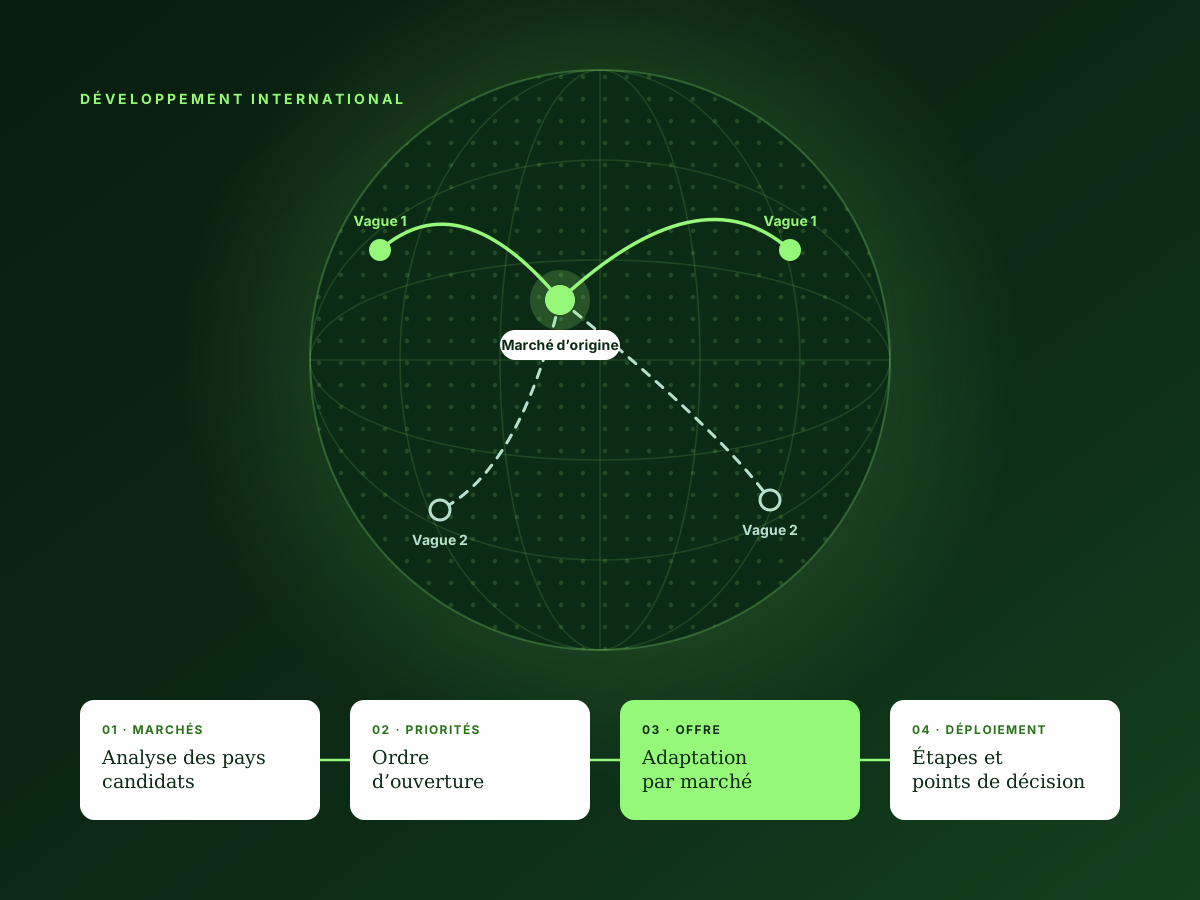
- Your challenges · 09I want to take my business internationalChoose the right markets, adapt your offer and roll out step by step.
- Practice 01Business consulting & strategyGood decisions start with a clear vision. We support leaders in their thinking, their direction and their transformation projects, then stay to see them through.
- 01 · ConsultingBusiness auditBefore changing anything, understand what is really going on. A Kopus audit gives you a clear, candid reading of your company: what works, what holds you back, and where to start.
- 01 · ConsultingBusiness growth and positioning strategyBe chosen rather than compared. We help you claim a clear place in your market and build the levers that will grow your company without weakening it.
Let’s bring your projects to lifeYour next project starts here.
If your priorities blur as the opportunities pile up, let’s talk about your strategy.
A scoping conversation, confidential