Practice 01 · Business consulting & strategyBusiness growth and positioning strategy: choose a growth you can sustain
Growing is rarely the problem. Growing without knowing why customers pick you is. When the value proposition stays vague, every new account adds complexity (bespoke products, commercial exceptions) faster than it adds results. The growth and positioning strategy Kopus develops with you connects your markets, your offer, your channels and your positioning to identify the growth levers your organisation can genuinely carry.
A confidential conversation about your options, no commitment
Reading frameworkThree horizons of growth, run side by side
A balanced growth strategy does not bet everything on today’s business, nor everything on distant wagers. It spreads effort across the core business that funds growth, the new activities being built and a few options tested on a small scale, each judged on its own indicators. This framework builds on the direction set by business strategy.
Horizon 10 to 12 months
Defend and extend the core business
Example moves
- Deepen the most profitable segments
- Rework the offer and pricing
- Retain existing customers
Horizon 212 to 36 months
Build new growth engines
Example moves
- Neighbouring segment with the same buying motives
- New territory
- Second sales channel
Horizon 3Beyond 36 months
Explore future options
Example moves
- Small-scale tests
- Exploratory partnerships
- Watch on emerging uses
Who it is for, and whenWhen to work on your growth strategy
The question arises as soon as future growth can no longer be a continuation of past growth.
- Your core market is reaching saturation and you are hesitating between new customer segments, new territories or new offers.
- You sell to everyone, and margins erode because each customer gets a different version of what you do.
- One sales channel (a reseller network, direct sales, online) dominates and you want to open a second without destabilising the first.
- You are preparing a fundraising round or a handover and need a growth plan that stands up to scrutiny.
The scopeThe levers Kopus examines and what you receive
The work covers four dimensions that shape one another.
Customers: who buys today, why, how profitable each segment is, and which neighbouring segments share the same buying motivations. Offer: which products or services carry the margin, which ones exist out of habit, and what would need adding or removing to serve the target segments. Channels: where your customers find you and buy from you, and which channels fit your production and service capacity. Positioning: the place you hold against the alternatives, and the place you want to hold.
From this study come contrasting growth scenarios, for example deepening an existing segment, expanding geographically or broadening the offer. Each scenario is sized in orders of magnitude (hiring, investment, cash) and assessed for compatibility with your current organisation. You receive the commercial priorities that follow, a phased rollout plan and the progress indicators for the chosen scenario.
What you get
- A clear promise your teams know how to explain.
- A structured offer and pricing you stand behind.
- A realistic growth plan, channel by channel.
The methodHow a growth strategy engagement runs
Analysis of the existing customer base: breakdown of revenue and margin by segment, by offer and by channel.
Interviews with representative customers and with your sales team to understand buying reasons and the objections they meet.
Construction of two or three growth scenarios with their assumptions, resource needs and risks.
Choice of scenario with management and translation into a rollout plan: sequence of actions, responsibilities, indicators.
Check-ins at the first milestones to adjust the plan against market feedback.
Your questionsFrequently asked questions about this service
Answers to the questions we are asked most often about this service. Another question? Ask us directly.
Ask a questionHow do you define a business growth strategy?
By linking four elements: the value proposition, the target markets, the available resources and the indicators that will measure progress. A strategy that neglects any one of them remains a wish with no way of checking it.
How does this differ from business strategy consulting?
Strategy consulting deals with the overall direction of the company and what it chooses to give up. Growth and positioning strategy focuses on the mechanics of growth: segments to serve, offer to evolve, channels to open, positioning to hold.
Do we need detailed customer data before starting?
The more structured your sales data, the sharper the analysis by segment. Without it, we rebuild orders of magnitude from invoicing and interviews, flagging the assumptions to confirm before any investment.
How is this different from a marketing strategy?
Positioning decides who you are and for whom; marketing strategy decides how to make it known. One comes before the other, and we can run both in sequence.
Do you work on international expansion?
Yes. We support companies opening up to new countries, in French and English, and adapt the positioning to each market.
What makes a good business positioning?
A clear, credible promise that differs from competitors’, that your customers recognise and your teams can explain in one sentence. Kopus formulates it, then checks it with real customers before rolling it out.
Does positioning mean changing the name or the logo?
Not necessarily. Sometimes a clarified positioning leads to a new identity, but the existing brand is often enough, provided messages and materials are adjusted.
Go furtherPages related to this service
Our workProjects built on this expertise
All our work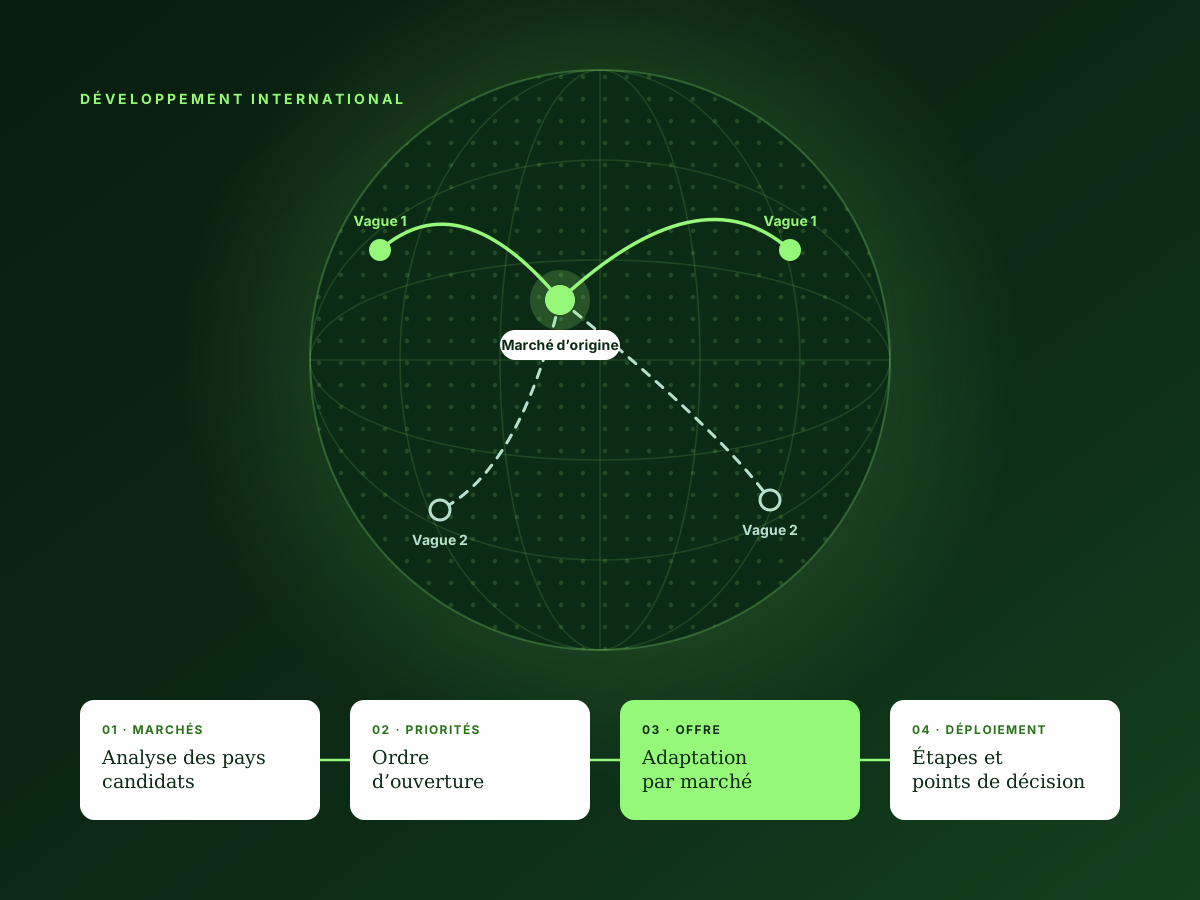
Let’s bring your projects to lifeYour next project starts here.
Let’s build the next stage of your growth on foundations you can hold.
A confidential conversation about your options, no commitment