Growth and organisationYour company is growing, but your organisation is struggling to keep up?
When a business speeds up, the habits that worked with ten people sometimes become fragile with thirty. Decisions go up to the owner, files multiply, roles overlap and lead times stretch. Kopus helps you identify what is really blocking things, rank the priorities and evolve your processes and tools at the pace of your company.
Sample mapReading a process as it actually runs, not as it is described
For each step, the map records who decides, which tool holds the information and when a file waits. A few blocking points often explain most of the delays: they are what the roadmap deals with first, separating what is a matter of method, organisation or tooling. When a step deserves to be automated, it shows on this map before it is decided.
Process map
From customer request to cash collection
- Step: 01Customer requestResponsible: SalesTool: Shared mailboxBlocking point: Smooth
- Step: 02QuoteResponsible: SalesTool: SpreadsheetBlocking point: File copied from the request, not linked to the customer record
- Step: 03ApprovalResponsible: OwnerTool: MessagingBlocking point: Approval by the owner for every quote
- Step: 04OrderResponsible: Sales administrationTool: Management softwareBlocking point: Quote re-keyed by hand
- Step: 05DeliveryResponsible: LogisticsTool: Paper scheduleBlocking point: Information missing when preparing
- Step: 06InvoicingResponsible: AccountingTool: Invoicing softwareBlocking point: Waits for the signed delivery note
- Step: 07Cash collectionResponsible: AccountingTool: Bank and tracking spreadsheetBlocking point: Smooth
Priority blocking pointPoint of attentionSmooth
Kept for the roadmap
| Blocking point | Nature | Lead |
|---|---|---|
| Approval | Organisation | Delegate according to rules everyone knows |
| Quote | Tooling | Link the quote to the request and to the customer record |
| Delivery | Method | Check the information at order time, not at departure |
What we seeGrowth reveals weaknesses that were invisible until now
Customer follow-up done by word of mouth is no longer enough once several teams are involved. Approvals pile up, information gets lost between departments, and one person becomes indispensable to unblock every file. Teams compensate with new spreadsheets or messages, but this parallel organisation ends up costing more time than it saves.
Adding software is not necessarily the first answer. You need to understand where the waiting is created, why responsibilities are ambiguous and which information is missing to make a decision.
Our approachMake processes readable before transforming them
We follow operations as they actually happen: from customer request to delivery, from order to invoice or from sale to support. We talk with the people who do the work, look at the data available and describe the day-to-day workarounds.
This analysis brings out a few priority causes. It separates a problem of method, organisation, training or tooling, and avoids launching everything at once.
How we workA roadmap suited to your capacity to execute
Kopus helps define an order of action: secure the essential practices, simplify hand-overs, improve existing tools, connect certain applications or build a specific solution when it is justified.
Each piece of work must have an owner, a realistic deadline, known dependencies and a success indicator. Depending on your needs, we can then design or deploy the chosen solutions, without separating the diagnosis from the implementation.
What you gainGrow without losing control of your business
You are looking for a more predictable organisation: files that are easy to find, clearer responsibilities and fewer decisions made in a hurry. Success is measured by concrete things, such as processing times, files reworked, re-keying, availability of information or time spent on certain approvals.
The right change is not the one that adds the most tools. It is the one the teams understand and can keep alive.
 Business software
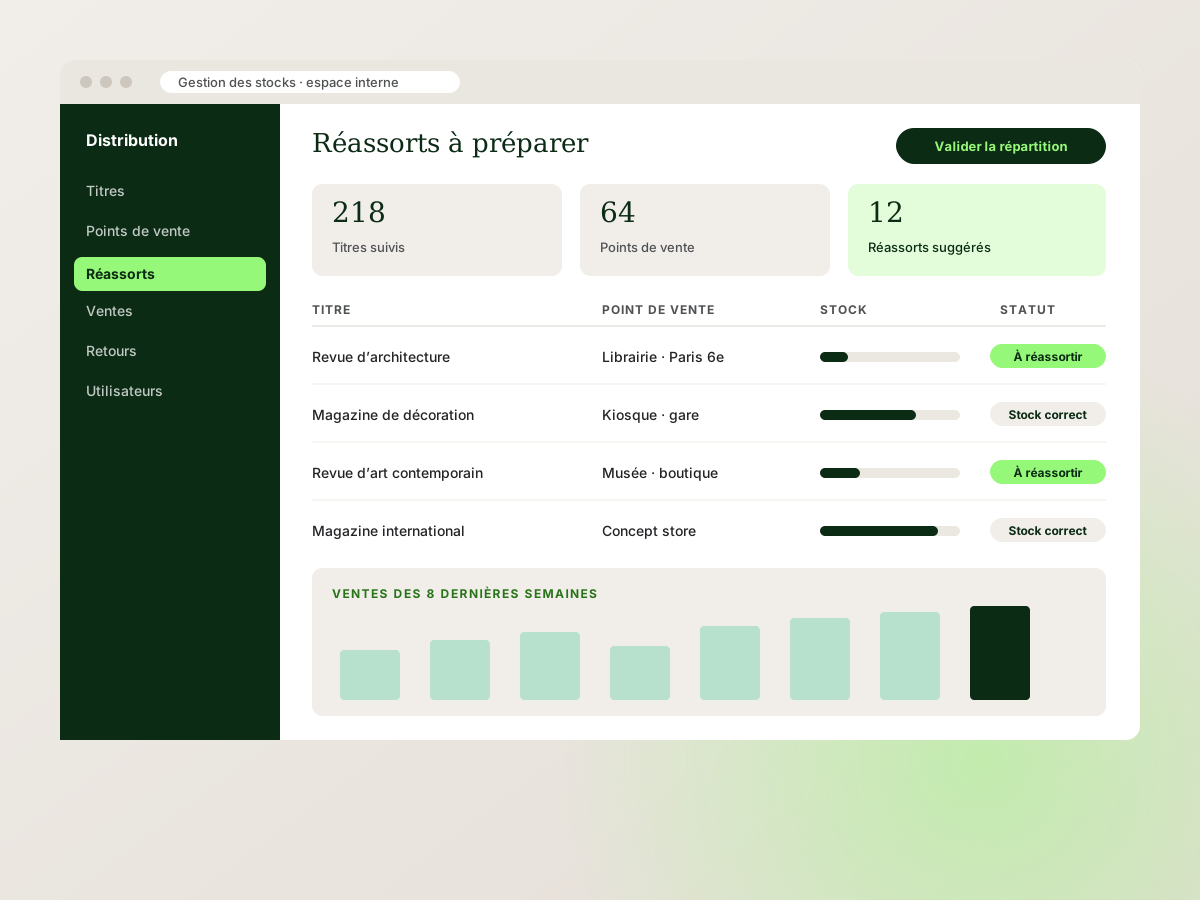
IPS Diffusion, an internal stock management interface
See the projectProjectIllustration: equipping a business process
The application built for IPS Diffusion tracks titles, stock, sales and restocking in a single internal environment. It illustrates how we start from a precise way of working to design a tool the teams adopt, rather than imposing generic software.
Your questionsFrequently asked questions
Ask a questionWe don’t know which problem to start with. Is that a blocker?
No. That is precisely the point of the diagnosis: confronting the irritants, the data and the observations to keep a few actionable priorities.
Do we need to overhaul the whole organisation?
Rarely. We first look for the most costly points of friction and the realistic changes, without systematically questioning everything that works.
Do you work with our teams and our tools?
Yes. The people concerned take part in the diagnosis, and the existing tools are taken into account. The scope and the level of involvement are defined upfront.
Can you also implement the solutions?
Yes, when the work falls within our expertise in strategy, software, web or automation. The diagnosis can also lead to recommendations to be carried out in-house.
Related servicesThe services that address this challenge
- 01 · ConsultingBusiness auditBefore changing anything, understand what is really going on. A Kopus audit gives you a clear, candid reading of your company: what works, what holds you back, and where to start.
- 01 · ConsultingDigital transformation consultingTransformation is not about stacking software. It is about rethinking how the company works, then choosing the tools that serve it. We help you do it in the right order and at the right pace.
- 03 · Web & softwareCustom business softwareInternal tools are rarely spectacular, but they are what saves every employee an hour a day. We design them with the people who will use them, so they are adopted from the first week.
Your challengesRelated challenges
My tools don’t talk to each other
Stop your teams re-entering the same data in several applications.
Explore this challenge Your challenges · 05I want to automate repetitive tasks
Free up time by simplifying repetitive, predictable operations.
Explore this challenge Your challenges · 10My customer service is overwhelmed
Absorb the repetitive requests and keep your advisers for the cases that matter.
Explore this challengeLet’s bring your projects to life
Your organisation can evolve without getting complicated.
Tell us about the delays, double entries, dependencies or bottlenecks that come with your growth. We will help you tell the urgent from the important.